


KMV1 Acoustic Camera Completes Mold Sealing Test And Locates Leak Points, Improving Production Efficiency!
With the continuous development of industrial technology, the leak detection of molds has become increasingly important. The emergence of the KMV1 acoustic camera has brought about significant changes in mold leak detection. KM1 acoustic camera utilizes a high-sensitivity microphone array to capture ultrasonic signals generated by leaks and converts these signals into intuitive images using advanced algorithms. The inspector simply point the device at the mold to be tested, and the location and intensity distribution of the leaks are clearly displayed on the screen. This non-contact detection method not only improves efficiency but also avoids potential damage to the mold that might be caused by traditional methods.
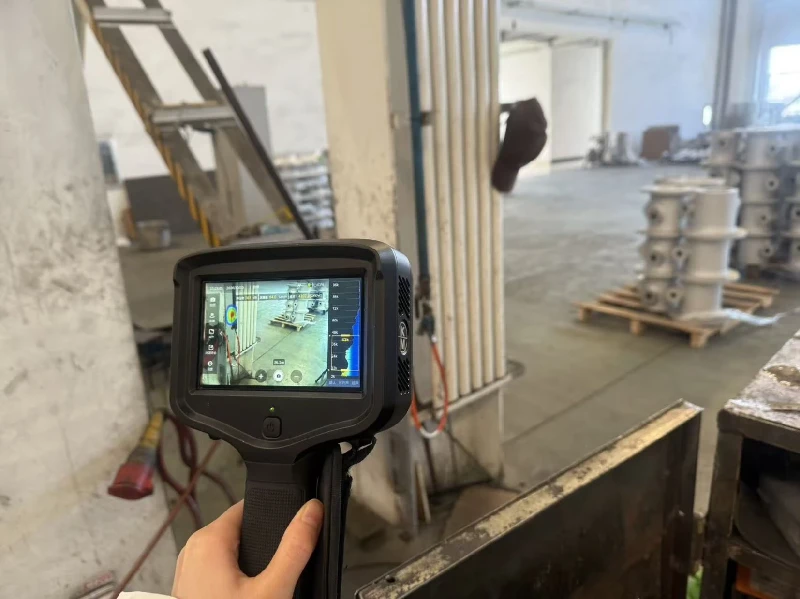
A customer in Shandong manufactures molds, and the finished products sometimes develop cracks. The customer needs to test the overall airtightness of these molds. Currently, they use a water immersion method, placing the finished molds in water to check for bubbles. However, their downstream customer requires that the molds not come into contact with water, necessitating a fast, non-destructive testing method. KM engineer brought KMV1 acoustic camera to the customer's site and successfully detected multiple leak points, perfectly meeting the customer's requirements.
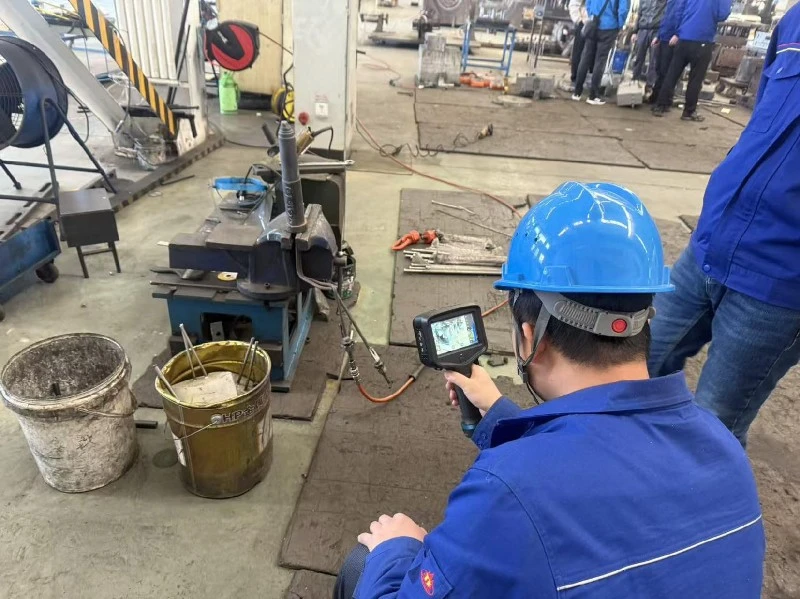
KMV1 acoustic camera detects mold seal leaks primarily based on sound wave propagation and reception technology. When a mold leaks, high-pressure gas or liquid inside is ejected through tiny gaps, creating turbulence and generating ultrasonic signals in a specific frequency range. Using beamforming technology to calculate the phase difference of the sound waves in real time, combined with a 96-microphone array, the leak point is superimposed on a visible light image in the form of a heat map. Compared to traditional water immersion or pressure decay methods, this technology offers the advantages of non-contact, real-time imaging, and quantitative evaluation, making it particularly suitable for rapid quality inspection on high-speed production lines.


