


Balancing Machine
Rich experience
Our products are developed from over 30 years experience and designed to achieve all necessary parameters to conduct a reliable machine analysis.
Technological development
We provides turnkey solutions for machinery Condition Monitoring in the predictive maintenance field. We develops and manufactures vibration measuring instruments, machine condition monitoring equipment and software with user functionality in mind.
Wide range of products
Vibration Analyzer; Portable Rotor Balancer; vibration meter; Wireless intelligent vibration sensor; Accelerometer; Dynamic Balancing.
Professional team
There is/are Above 50 People R&D Engineer(s) in the compan. With a professional R & D team and leading scientific research ability.


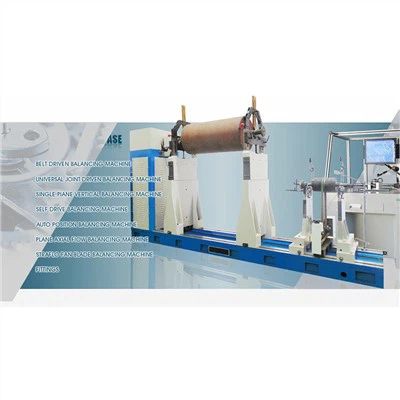
What Is Balancing Machine
A balancing machine is a measuring tool used for balancing rotating machine parts such as rotors for electric motors, fans, turbines, disc brakes, disc drives, propellers and pumps. The machine usually consists of two rigid pedestals, with suspension and bearings on top supporting a mounting platform. The unit under test is bolted to the platform and is rotated either with a belt-, air-, or end-drive. As the part is rotated, the vibration in the suspension is detected with sensors and that information is used to determine the amount of unbalance in the part. Along with phase information, the machine can determine how much and where to add or remove weights to balance the part.
Importance of Balancing Machine
Balancing machine is a critical aspect of rotating equipment design, operation, and maintenance, as it ensures the proper distribution of mass and forces within the system. The importance of balancing machine in rotating equipment can be summarized as follows:
Prevents excessive vibration: Balanced rotating equipment operates smoothly without excessive vibration. Unbalanced equipment can generate high levels of vibration, leading to increased stress on components, increased wear, and potential damage to equipment over time. Excessive vibration can also cause noise, discomfort for operators, and structural damage to the surrounding environment. Balancing machine helps minimize vibration, ensuring smooth operation and reducing the risk of equipment failure.
Enhances equipment performance: Balanced rotating equipment performs optimally, leading to improved operational efficiency and effectiveness. Unbalanced equipment can result in reduced performance, increased power consumption, decreased efficiency, and compromised system performance. Proper balancing machine helps ensure that equipment operates at its designed performance levels, maximizing productivity, and minimizing energy consumption.
Extends equipment life: Balanced rotating equipment experiences less wear and tear on components, leading to longer service life. Unbalanced equipment can result in increased loads, stresses, and premature wear on bearings, shafts, couplings, and other components. Proper balancing machine helps reduce the risk of premature failure, extending the operational life of equipment and minimizing maintenance costs.
Enhances safety: Balanced rotating equipment is safer to operate. Unbalanced equipment can generate excessive vibration and forces, leading to potential safety hazards for operators and other personnel. For example, excessive vibration can cause equipment to shake, become unstable, or malfunction, posing risks of slips, trips, falls, or other accidents. Proper balancing machine helps minimize such risks, ensuring a safe working environment for operators and other personnel.
Reduces downtime and maintenance costs: Balanced rotating equipment experiences fewer failures, resulting in reduced downtime and maintenance costs. Unbalanced equipment can cause increased wear on components, leading to more frequent repairs, replacements, and maintenance activities. Balancing machine helps minimize wear and tear on components, reducing the frequency of maintenance interventions and associated costs.
Attributes of a Balancing Machine
The following features characterize a good balancing machine:
● High accuracy.
● Repeatable measurements.
● Easy to set up and operate.
● Adaptable to a wide range of parts.
● Permanent calibration – no need for time consuming calibration runs.
● Eliminate/minimize outside influences on measurements.
● Reliable and dependent design.
● Good customer service and support.

Unbalance is a vector quantity, i.e. it has a magnitude and a direction. The magnitude of the unbalance is defined as a composite product (multiplication) value of mass (m) times radius (r). m x r. This is the measured quantity internally in balancing machines. The user feeds a radius of correction desired r, and the machine computes the unbalance mass m based on the measured unbalance value. The direction of the unbalance is the angle measured from a known reference on the balancing machine. Thus the units in metric will be g-mm. An example of unbalance would be 10 g-mm @ 45 degrees. The reference could be fixed on the rotor, like a reflective sticker, or internally in the machine. In some literary references, the unbalance is referred in terms of eccentricity, measured in microns for the metric system. This measurement normalizes the unbalance with respect to the rotor weight. I.e, it is the unbalance divided by rotor weight or mxr/M, where M is the mass of the rotor. While doing the division, take care to use consistent units, i.e. if mxr is units of g-mm, M should be in grams.
For practical unbalance correction, one needs to know the unbalance value in a weight value say grams. This is achieved by dividing the unbalance value by the radius. Thus a 50 g-mm unbalance at 100 mm radius, needs a correction of 50 g-mm/100 mm, i.e. 0.5 grams.
Modern balancing machines supplied by Precibalance indicates both the g-mm value as well as the value in grams as well as a combination of many other non metric mass and length units such as oz-in, lb-in etc.
For interpretation of the effect of unbalance, the magnitude is the relevant value. The angle is relevant for determining the location of the unbalance. The angle can be any value between 0 to 360 degrees on the rotor. Thus a component with unbalance of 5 g-mm @ 355 degree is better balanced than one at 10 g-mm @ 5 degree.
It should be noted that for quantifying and comparing the effect of unbalance masses, both the unbalance mass and radius is important. This is because the centrifugal force generated by a rotating mass is m x ω x ω x r, where m and r are the unbalance mass and radius of correction and ω is the angular velocity defined as ω = 2*pi*RPM/60. Normalizing with the RPM, the centrifugal force generated by the unbalance is quantified by the product m x r. So, a 10 grams unbalance at 100 mm radius, i.e. 10×100 = 1000 g-mm of unbalance has the same effect as a 20 grams unbalance at 50 mm radius, i.e. 20×50 = 1000 g-mm.
How Does the Balancing Machine Work
Balancing machines measure, analyse, and correct unbalance in rotating components. The general process includes:
Component is mounted on the support system: The machine can accommodate different sizes and shapes of components.
Component vibration is measured: Sensors, such as accelerometers or laser sensors are used to collect data regarding the amplitude and phase of the vibrations.
Data is analysed: This analysis helps to determine the type and amount of unbalanced in the component, as well as the location and magnitude of the heavy spot.
Unbalance correction: The amount of weight which needs to be added or removed to achieve balance is calculated typically by adding counterweights.
Balancing is carried out: Balance weights are applied (using bolts, welding, adhesive or balance putty) at specific locations on the component to achieve balance.
Component is remeasured: Once weight has been added or removed, the component is re-measured to check the unbalance has been reduced to an acceptable level. This may be repeated to achieve desired balance.

There are three types of balancing machines:
Balancing machines for universal balancing
These devices can detect both static and dynamic imbalance.
Balancing machines for dynamic balancing
These devices solely measure dynamic imbalance.
Balancing machines for static balancing
These devices solely measure static imbalance.
Here are top 5 technology features of balancing machines
Real-time monitoring system
Balancing machines have become a key component of modern manufacturing processes, providing precise measurement and correction of rotor imbalances. One of the most important features of balancing machines is the real-time monitoring system, which enables continuous measurement and adjustment of the balancing process. By providing detailed feedback on rotor vibration and balance, the real-time monitoring system ensures high-accuracy balancing that meets the strictest quality standards. This feature also offers benefits in terms of reducing cycle time and increasing productivity, as it enables operators to make quick adjustments to the balancing process in response to changing conditions or requirements. With its advanced technology and user-friendly interface, the real-time monitoring system is an essential feature of balancing machines that helps balancing machine manufacturers achieve the highest levels of precision and efficiency in their operations. So if you're looking to take your manufacturing process to the next level, a machine with a real-time monitoring system is a must-have.
Automated correction system
Balancing machines these days come equipped with automated correction systems. These nifty features help in reducing human error and improving overall balancing quality. Not to mention, they also reduce the time taken to set up the machine for operation. Imagine the amount of time it would take to manually calibrate the machine accurately each time a new part is introduced. You'd probably be balancing your machine more than the actual part! With the automated correction system, all this is taken care of, ensuring accurate and efficient performance every time.
Compatibility with various types of rotors and applications
Compatibility with various types of rotors and applications is a crucial feature of balancing machines. With the increasing diversity of manufacturing processes, it is essential to have a machine that can handle different types of rotors and applications. This feature ensures versatility and flexibility in manufacturing processes. With a balancing machine that can handle different types of rotors and applications, manufacturers can reduce downtime significantly. They can also increase overall efficiency by having one machine that can handle multiple applications instead of several machines specialized in specific tasks. The compatibility feature also ensures that manufacturers do not need to purchase new machines as their manufacturing needs evolve. They can, therefore, save on equipment costs. With this feature, manufacturers can quickly adapt to changes in their production lines without experiencing additional expenses. In summary, compatibility with various types of rotors and applications is a must-have feature in balancing machines. It is essential in ensuring versatility and flexibility in manufacturing processes while reducing downtime and equipment costs.
Ease of use and user interface
Let's be honest; nobody has time to sit around for hours trying to figure out how to operate a balancing machine. That's why the ease of use and user interface is a crucial feature in balancing machines. The best balancing machines are those that can be operated without extensive training and can be effectively integrated into the production line. The importance of a user-friendly interface cannot be overstated. Improved user engagement leads to a higher level of accuracy as well as minimizing operational errors that could lead to downtime. A well-designed user interface increases operator engagement, making it easier for them to monitor and adjust settings as needed. Reducing training time is also vital in modern manufacturing processes due to the high turnover rates. A balanced machine that requires minimal training will save time and cost in the long run. Fortunately, balancing machines understand this requirement and invest in creating user-friendly interfaces that require minimal training. In summary, ease of use and user interface are vital features in balancing machines. They offer benefits such as reduced training time, improving user engagement, and minimizing operational errors, leading to a higher level of accuracy.
Data management and analysis system
Data management and analysis system is a must-have feature in balancing machines. It provides valuable insights for optimizing processes and predicting maintenance needs. With this feature, manufacturers can enhance overall equipment effectiveness while reducing maintenance costs. The system helps in monitoring performance and detecting issues in real-time, making corrective measures more timely and cost-effective. By analyzing data collected from the system, manufacturers can identify patterns and trends, making it easier to optimize the manufacturing process. This way, operators can focus more on improving the quality of the final product.
Our Factory
KM Instrument is a global leader in condition monitoring technology. we provides turnkey solutions for machinery Condition Monitoring in the predictive maintenance field. we develops and manufactures vibration measuring instruments, machine condition monitoring equipment and software with user functionality in mind. Our products are developed from over 30 years experience and designed to achieve all necessary parameters to conduct a reliable machine analysis. With a professional R & D team and leading scientific research ability, the KM series products from KM have a solid reputation for quality and excellent performance.
Our products are used widely in industry and we believe our success comes from our focus on simplicity with a high performance to cost ratio. We continue to move forward and establish new markets in developing areas. The strength of our product range comes through development which has involved some of the world's leading professionals in vibration analysis.

Our Certificate
ISO9001,CE,IP67

