


Vibration Analyzer
Rich experience
Our products are developed from over 30 years experience and designed to achieve all necessary parameters to conduct a reliable machine analysis.
Technological development
We provides turnkey solutions for machinery Condition Monitoring in the predictive maintenance field. We develops and manufactures vibration measuring instruments, machine condition monitoring equipment and software with user functionality in mind.
Wide range of products
Vibration Analyzer; Portable Rotor Balancer; vibration meter; Wireless intelligent vibration sensor; Accelerometer; Dynamic Balancing.
Professional team
There is/are Above 50 People R&D Engineer(s) in the compan. With a professional R & D team and leading scientific research ability.
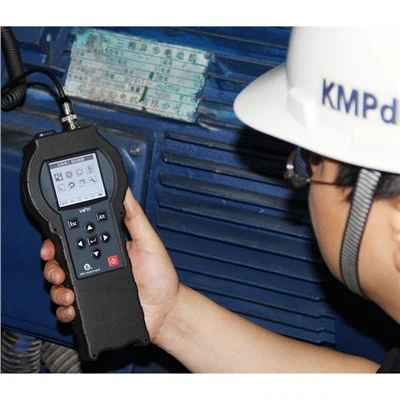

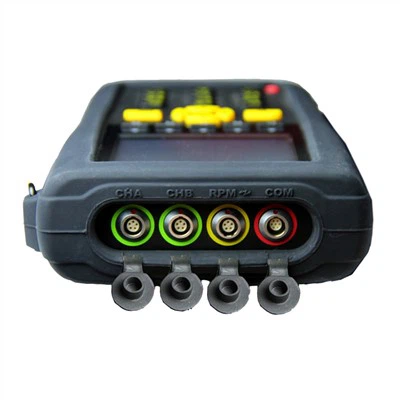


What Is Vibration Analyzer
Technicians use vibration analyzers to measure, store, and analyze the vibrations produced by industrial equipment or installations.
Rotating machines – like compressors, pumps, and fans – all vibrate while in operation. Every machine produces its own, baseline level of vibration, or vibration "signature."
Changes in vibration levels or vibration frequency can mean that your asset is developing a new defect. Over time, excessive vibration can damage machinery and create dangerous conditions on your floor. But changes in vibration patterns can also indicate underlying issues like misalignment, imbalance, and bearing faults.
Vibration analyzers measure changes in vibration frequency, displacement, and acceleration. They store vibration data so that you can easily spot patterns and changes over time.
Some vibration analyzers can also use vibration data to diagnose problems in the field. In many cases, good analyzers can also guide technicians through the process of the machine fault.
How Does Vibration Analyzer Work
Vibration analyzer is a process that monitors vibration levels and investigates the patterns in vibration signals. It is commonly conducted both on the time waveforms of the vibration signal directly, as well as on the frequency spectrum, which is obtained by applying Fourier Transform on the time waveform.
The time domain analysis, on chronologically recorded vibration waveforms, reveals when and how severe the abnormal vibration events occur, by extracting and studying parameters including but not limited to root-mean-square (RMS), standard deviation, peak amplitude, kurtosis, crest factor, skewness and many others. Time domain analysis is capable of evaluating the overall condition of the targets being monitored.
In real world applications, especially in rotating machinery, it is highly desirable to incorporate the frequency spectrum analysis in addition to time domain analysis. A complex machine with many components will generate a mixture of vibrations, which is a combination of vibrations from each rotating components. Therefore, it is difficult to use only time waveforms to examine the condition of the critical components such as gears, bearings and shafts in a large rotating equipment. Frequency analysis decomposes time waveforms and describes the repetitiveness of vibration patterns, so that the frequency components corresponding to each components can be investigated. Additionally, the well-established Fast Fourier Transform (FFT) technique facilitates fast and efficient frequency analysis, as well as the design of various digital noise filters.

A measure is a unit or standard of measurement that provides a means of evaluating data.. Three vibration measurements are available – displacement, velocity e acceleration. Ideally the transducer will directly provide the selected measurement. Unfortunately, transducer limitations do not always allow direct measurement of vibration in the proper way.
The measurement is selected based on the frequency content of the vibration present, in machine design, on the type of analysis to be conducted (by ex. defects, condition, information about the design), and the information sought.
1.Displacement
● Absolute displacement, which is used for low frequency structural vibration (0 a 20Hz), is related to the voltage (shaft or structure) and is usually measured with a dual integration accelerometer. The absolute displacement of a shaft must be measured with a contact transducer or with a non-contact transducer in combination with a seismic transducer. Unfortunately, frequency must also be considered when severity of displacement and acceleration are evaluated.
● Drelative displacement from the shaft, which is measured with a proximity probe, shows the extent of bearing play used by vibration and is used over a wide range of frequencies. Relative displacement is usually measured, between bearing housing and rotor, by a permanently mounted proximity probe.
2. Velocity
For machine monitoring and analysis, in general, no interval 10 hz up to 1000 Hz, a velocity is the measure used by default. The velocity, which is the time rate of change of displacement, is dependent on frequency and displacement and is related to fatigue. It has been shown to be a good measure in the range from 10Hz to 1000 Hz because a single value can be used for rms or peak velocity in undemanding condition assessments, no need to consider the frequency. the most modern data collectors use accelerometers and the signal must be integrated to obtain the velocity.
3. Acceleration
A acceleration is the measure used above the 1000 Hz, is related to strength and is used for high frequencies such as meshing and bearing defects. Acceleration and velocity are absolute measurements taken at or as close to bearing housings as possible.
Vibration Analysis Methods for Vibration Analyzers

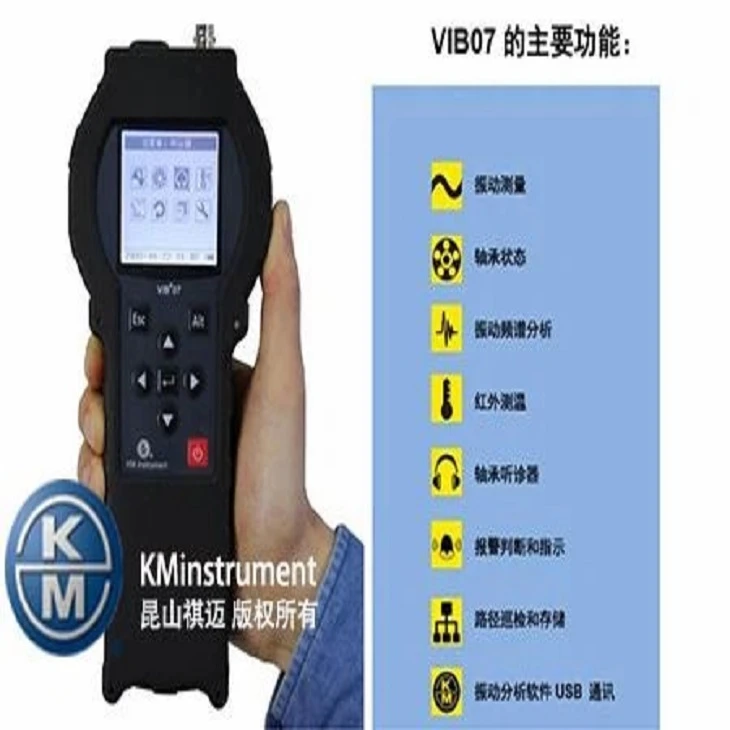

Vibration analyzer is generally broken down into four principles, and each principle gives you specific information on the working conditions and features of the vibrating parts.
● Time domain: When a vibration signal is picked up from a transducer (device that converts a physical quantity into an electrical signal) and displayed on the screen of an oscilloscope, it's called a waveform. This signal is in the time domain. The time domain is amplitude plotted against time. While most machine vibration issues are detected using spectrum analysis, some types are more easily seen in waveform.
● Frequency domain: When the waveform discussed earlier is subjected to spectrum analysis, the end result is a picture of frequency vs. amplitude, known as a spectrum. The spectrum is in the frequency domain like the vibration is in the time domain. Most in-depth analysis of machinery vibration is done in the frequency domain or using spectrum analysis.
● Joint domain: Because vibration signals vary with time, calculating more than one spectrum at once can be useful. This technique is used to calculate variations of the fast Fourier transform, including short-time Fourier transform (STFT).
● Modal analysis: Modal analysis takes measured frequency response functions of a piece of machinery and puts them into a computer model. The computer model can be displayed with animations of all the different vibration modes. The model can be adjusted by either adding to or taking away things like mass or stiffness to see the effects.
Outside of these four basic principles lie numerous forms of analysis, calculations and algorithms used to determine different aspects of vibration analyzer. These include:
● Time waveform: A time waveform is acceleration vs. time displayed as tables and plots. Time waveforms show a short time sample of raw vibration, revealing clues to the condition of machinery not always clear in the frequency spectrum. A method of employing time waveform vibration signals as a vibration analyzer tool is by using FFT.
● Fast Fourier Transform (FFT): FFT is defined as an algorithm used to calculate a spectrum from a time waveform. In other words, it's a calculation intended to break down a signal into all its frequencies. If you'll recall time domain and frequency domain discussed above, FFT converts a signal from the time domain into the frequency domain. Fast Fourier transform is most often used for detecting machine faults like misalignment or unbalance.
● Phase measurement: When talking about vibration analyzer, phase is a relative time difference between two signals measured in units of angle as opposed to time. It only works if the two signals being compared are of the same frequency. Phase measurement is used in tandem with FFT to decipher machine faults like loose parts, misalignment and unbalance.
● Order analysis: Order analysis is a variation of FFT analysis and is mostly used to quantify vibrations of machines with varying revolutions per minute (RPM). In other words, order analysis is frequency analysis where the spectrum's frequency axis is shown in orders of RPM rather than hertz. The term "orders" refers to a frequency that is a multiple of a reference rotational speed. For example, if a vibration signal is equal to twice the frequency of the motor's rotation, the order is two.
● Power spectral density (PSD): Power spectral density is calculated by multiplying the amplitude from the FFT by its different forms to normalize it with the frequency bin width (bin width refers to the grouped x-axis values). Think of PSD as looking at "random" vibrations or motion at many different frequencies. PSD accurately compares random vibration signals that have different signal lengths.
● Envelope analysis: Envelope analysis is a form of vibration analyzer that can detect impacts with very low energy often hidden by other vibration signals. It's a popular diagnostic tool for damaged gear teeth and roller bearings.
● Orbit: The orbit is defined as a plot of a sleeve bearing journal's centerline. It's measured by placing two probes in the bearing housing 90 degrees apart. Data from these probes can be displayed digitally and used to detect shaft vibrations caused by oil whirl - oil whirling around inside, causing the journal to move.
● Resonance analysis: Resonance analysis identifies all the natural vibrations and frequencies in machines. The presence of resonance means high vibration, which could reach damaging levels.
What Can Vibration Analyzer Detect
Time domain vibration analyzer is able to monitor vibration levels. Acceptable operation vibration limits can be pre-defined either through long-term operation and maintenance history or through referring to established standards. If the limit is breached, this could be that the overall health condition of the machine is deteriorating and defects have developed.
Frequency domain vibration analyzer excels at detecting abnormal vibrating patterns. For instance, a crack that has developed on a roller bearing outer race will lead to periodic collisions with bearing rollers. In time waveform, this information is usually hidden and masked by the vibration from other sources. By studying the frequency spectrum, the periodicity of the collisions can be discovered and thus detect the presence of bearing faults.
The Benefits of Using a Vibration Analyzer
Implementing vibration analyzer as part of a predictive maintenance program offers numerous benefits:
Early fault detection: Vibration analyzer can detect developing faults in machinery long before they become visible or audible to human senses. These early detection capabilities help maintenance teams schedule repairs or replacements before a failure occurs, reducing downtime and improving overall productivity.
Improved maintenance scheduling: By identifying the severity of machine faults, vibration analyzer allows maintenance teams to prioritize their efforts and allocate resources more effectively. This targeted approach can result in significant cost savings and improved equipment reliability.
Reduced maintenance costs: Finding and fixing machine faults before they lead to catastrophic failures can help organizations avoid costly repairs and equipment replacements. Furthermore, predictive maintenance based on vibration analyzer can extend the lifespan of machinery, further reducing long-term capital expenditures.
Enhanced safety: Vibration analyzer can play a crucial role in maintaining a safe working environment for employees. Proactively detecting and addressing potential mechanical failures significantly reduces the risk of accidents and injuries in the workplace.
Improved energy efficiency: Faulty machinery often consumes more energy than it should, leading to increased operating costs. Rectifying issues using vibration analyzer helps organizations optimize asset efficiency and reduce energy consumption.
Our Factory
KM Instrument is a global leader in condition monitoring technology. we provides turnkey solutions for machinery Condition Monitoring in the predictive maintenance field. we develops and manufactures vibration measuring instruments, machine condition monitoring equipment and software with user functionality in mind. Our products are developed from over 30 years experience and designed to achieve all necessary parameters to conduct a reliable machine analysis. With a professional R & D team and leading scientific research ability, the KM series products from KM have a solid reputation for quality and excellent performance.
Our products are used widely in industry and we believe our success comes from our focus on simplicity with a high performance to cost ratio. We continue to move forward and establish new markets in developing areas. The strength of our product range comes through development which has involved some of the world's leading professionals in vibration analysis.

Our Certificate
ISO9001,CE,IP67

