


Products
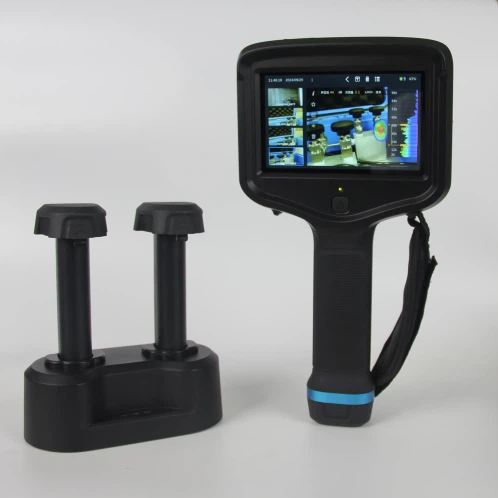


Acoustic Camera
We can find in our daily lives that humans use their eyes to collect information faster and more intuitively than any other organ. This is why in many industries, "visual" monitoring of complex processes is required. At the same time, many technologies were invented that expanded areas...
Features
We can find in our daily lives that humans use their eyes to collect information faster and more intuitively than any other organ. This is why in many industries, "visual" monitoring of complex processes is required. At the same time, many technologies were invented that expanded areas of human vision that were generally invisible to the eye. Nuclear magnetic resonance imaging (MRI),X-ray machines, and infrared thermal imaging cameras are some examples of technologies that allow humans to "see" invisible matter. However, there are currently only some basic ways to measure noise, such as noise meters. What advantage would we have if noise could also be seen? What would everything around us "look" like through an acoustic imaging system?
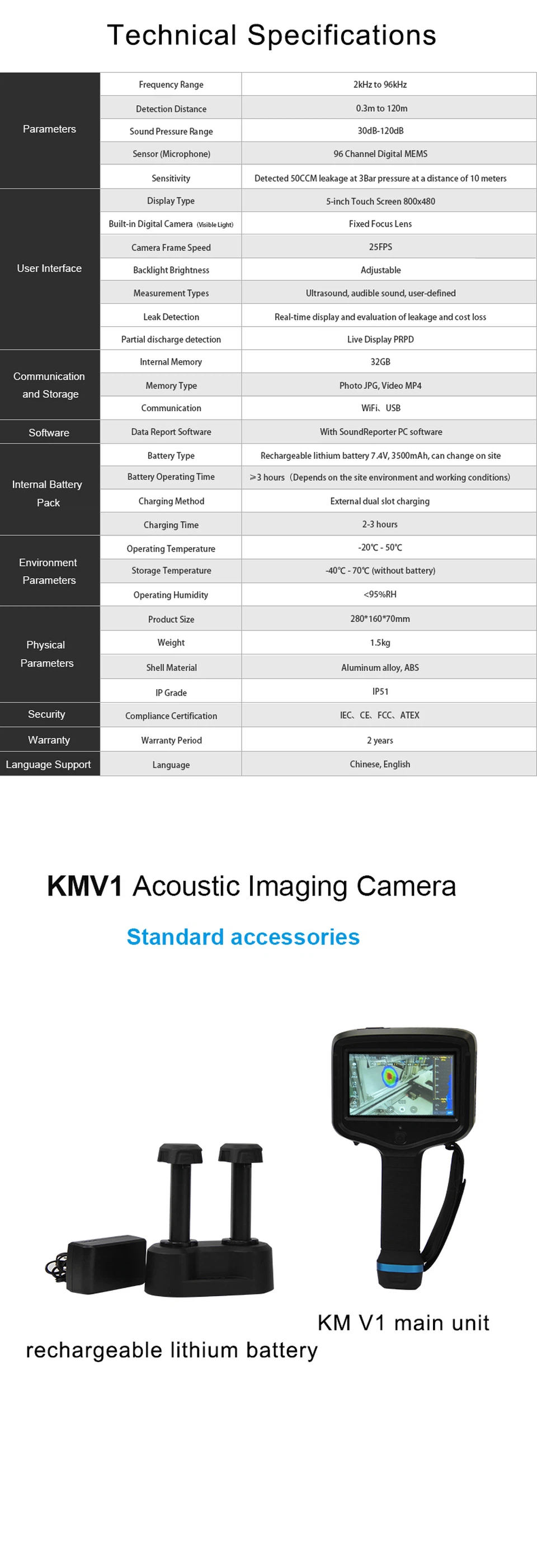
KM V1 has been developed to visualize the applications of the world-renowned acoustic brand KM, such as compressed gas leakage, local discharge detection in electrical equipment, space tightness testing, etc., using acoustic visualization technology. The use of nearly a hundred high-precision digital micro- phones improves measurement sensitivity, and can measure signals in the ultrasonic frequency band of up to 96 kHz. In addition, excellent performance can be achieved in detecting high-frequency noise, including BSR(Buzz, Squeak, Rattle) noise. The KM V1 acoustic imaging system is a new type of noise source identification,positioning and test analysis system. It uses a high-sensitivity digital microphone to visualize the collected sound on the screen in the form of a color contour map. Effectively measure the sound field distribution, the sound image and the visible light video image are perfectly superim- posed, forming a detection effect similar to that of a thermal imager on the temperature of an object. It can quickly identify and locate steady-state, transient and moving sound sources, help people intuitively understand sound waves, sound fields, and sound sources, understand the locations and causes of noise generated by machinery and equipment, and then find ways to manage and control noise.


No Information
You Might Also Like


Send Inquiry
